
Random Question Generator for Kids

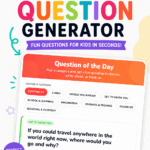
Use this random question generator for kids to instantly create fun conversation starters, classroom warm-ups, and writing prompts for elementary, middle school, and high school students.
Pick an age group and category below to generate your question of the day. You can avoid repeats, share questions, or use full-screen mode for the classroom.
Question of the Day Generator
Choose an age group and category, then generate a kid-friendly question for morning meetings, writing prompts, brain breaks, or conversation starters.
How to Use the Random Question Generator
Choose an age group, then pick a question type or leave it on Surprise Me. Click Get a Question and a random prompt will appear instantly.
Keep Avoid Repeats switched on when using it with a group, or reset the questions whenever you want to start again. You can also copy, share, or print any question, and Full Screen makes it easy to display on a classroom board.
Use the questions for morning meetings, writing prompts, brain breaks, classroom discussions, or simply as a quick way to get kids talking. For something more interactive, try the icebreaker question spin the wheel. It works in a similar way but lets kids spin the wheel to choose their question.
If you want something completely different, browse my collection of random generators for games, creative ideas, names, topics, and more.
Get Kids Writing Every Day with This Fun Journal
When to Use a Question of the Day Generator
A question of the day works well in the small gaps between activities without needing a whole lesson built around it. Morning meetings and lesson transitions are obvious times to use it. One quick question can get everyone talking while they settle in or reset attention before moving on to the next subject.
It also works well for classroom discussions and writing. Choose a question with no obvious right answer and ask students to explain their reasoning, or use one as a ready-made writing prompt. Full-screen mode makes it easy to put the question up for the whole class.
And it doesn’t have to be a school activity. At home, use a question over dinner, in the car, or whenever you want something more interesting than asking what everyone did that day.
Question Ideas by Category
Different categories work better depending on what you want from the activity.
Funny – easy, low-pressure questions that work well for brain breaks and slower mornings.
Would You Rather – great for getting kids to choose a side and explain why. These often lead to much longer discussions.
Get to Know You / Favorites – useful with a new group, at the beginning of the school year, or whenever you want a more personal conversation starter.
Classroom & Learning / Imagination – better when you want more thinking, creativity, or a question that can become a written response.
Kindness & Feelings – useful for conversations about friendship, emotions, empathy, and classroom community.
Surprise Me – choose this when you don’t care about the category and just want something unexpected.
Making More of a Good Question
If a question gets everyone talking, it’s easy to extend it without turning it into another planned activity.
Have students discuss it in pairs before sharing with the group, ask them to explain why they chose their answer, or use my random debate topic generator to take the discussion further.
For writing, put the question at the top of a page and give students five or ten minutes to respond. Questions without an obvious right answer tend to work particularly well, especially the imagination and Would You Rather prompts.
You can also turn the activity into an art prompt with our drawing challenge generator, which gives kids a random idea to draw.
Last Updated on 26 August 2026 by Clare Brown
