
Attendance Percentage Calculator for Students & Homeschoolers


I built this attendance percentage calculator because I was tired of double-checking my own math.
When you’re homeschooling (or even just trying to keep track of school absences), it’s surprisingly easy to lose track of where you actually stand. A few sick days here, a long weekend there, and suddenly you’re wondering if you’re still above 90%.
So instead of pulling out a calculator every month, I made one that does it instantly.
Attendance Percentage Calculator
Track attendance, estimate days you can miss, or log homeschool progress.
Attendance percentage
Days you can miss
Homeschool attendance tracker
How to use this School Attendance Calculator
Start with the section that matches what you’re trying to figure out.
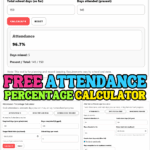
If you already know how many school days have happened and how many were attended, just enter those numbers. The calculator will show your attendance percentage immediately.
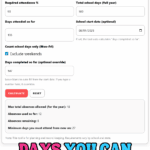
Trying to plan ahead? Use the “Days you can miss” tab. Enter the total school days for the year and your required percentage (90% is common in many states). You can type in the days completed so far, or add your school start date and let the tool estimate it.
You’ll see:
- your current percentage
- how many absences you’ve already used
- how many you can still afford
For homeschool families, the tracker section works like a simple homeschool hours log. Enter the required days (or convert your hours into days) and the number you’ve completed. It gives you a quick snapshot of where you stand and how much of the year is left.
It’s simple on purpose, just clear numbers without extra steps.
How Many School Days Are Required Each Year?
In most U.S. states, the school year falls somewhere between 170 and 180 days. Many public schools stick with 180 days, but the exact requirement depends on state law.
Some states measure attendance in days. Others use instructional hours instead. Elementary students often need around 900 hours per year, while middle and high school requirements usually land between 1,000 and 1,080 hours.
Homeschool rules can vary even more. Some states require a set number of days, some require hours, and a few simply expect instruction that’s equivalent to public school without specifying exact totals.
If you’re not sure what applies to you, it’s worth checking your state’s Department of Education site or a HSLDA homeschool law summary. Requirements can shift, and it’s always better to confirm than assume.
How Many Days Can You Miss With a 90% Attendance Requirement?
A 90% requirement simply means you need to attend nine out of every ten school days.
What that looks like depends on the length of the school year.
- In a 180 day year, you must attend 162 days. That leaves 18 absences.
- In a 175 day year, you need 158 days (rounded up), which gives you 17 days you could miss.
- In a 170 day year, you must attend 153 days, again leaving 17 absences.
The quick way to calculate it yourself:
Total school days × required percentage = minimum days you must attend.
The difference is how many days you can miss.
Where things get tricky is mid-year. Once you’ve already missed a few days, the margin shrinks faster than most people expect. That’s when running the numbers again can be helpful.
For homeschool families tracking instructional time, the same idea applies. Whether you’re counting days or converting hours into equivalent days, the key is knowing your yearly total so you can see how much flexibility you actually have left.
How to Improve Attendance Before it Becomes a Problem
Attendance problems usually don’t show up all at once. It’s more often a few random sick days, a long weekend, a doctor’s appointment, and suddenly you’re closer to the line than you expected.
The biggest difference-maker is simply checking your numbers earlier in the year instead of waiting until spring. When you know your current percentage and how many school days are left, small adjustments are easy. Waiting until you’re close to 90% makes everything feel urgent.
I learned this during one winter when we had back-to-back illnesses. On paper, we thought we had “plenty of days left.” Once I actually ran the numbers, the cushion wasn’t as big as I assumed.
It also helps to understand exactly what your state requires. Some measure days, others measure instructional hours. If you’re homeschooling and tracking hours, converting those into equivalent days periodically keeps you from falling behind without realizing it.
And finally, treat your allowed absences as a safety net, not something to use up. If your year is 180 days and you technically have 18 days you could miss, it’s better to think of those as emergency days. Life happens. Having that buffer matters.
Most attendance issues build slowly. A quick check once a month is usually enough to stay comfortably on track.
Frequently Asked Questions
Divide the number of days attended by the total number of school days completed, then multiply by 100.
For example, if 125 out of 147 days were attended:
125 ÷ 147 × 100 = 85%
This is the same calculation used by most schools and attendance tracking systems.
Absentee rate measures the percentage of days missed rather than attended.
Days missed ÷ total school days × 100.
If 22 days were missed out of 147:
22 ÷ 147 × 100 = 15%
Attendance rate and absentee rate together equal 100%.
Most schools calculate attendance using:
Days attended ÷ total required days × 100.
Many states require students to maintain at least 90% attendance. Some states measure instructional hours instead of days, but the percentage calculation works the same way, completed instruction compared to required instruction.
At 95% attendance, you can miss 5% of the school year.
In a 180-day school year:
180 × 0.05 = 9 days.
In a 170-day year:
170 × 0.05 = 8.5 days, meaning missing more than 8 days would typically drop attendance below 95%.
Yes. Homeschool families can calculate attendance as a percentage even if their state requires instructional hours instead of days.
Simply divide completed days (or hours) by the total required for the year and multiply by 100.
Using a percentage makes it easier to see progress at a glance and ensure state requirements are being met.
More Tools and Printables to Help You Stay on Track
Over the years, I’ve found that attendance is much easier to manage when everything connects. Instead of separate trackers and spreadsheets, I prefer tools that give a quick snapshot of the whole year.
If you’re counting forward through the year, the When Is the 100th Day of School Calculator makes it easy to see where that milestone falls based on your start date.
For families who prefer paper planning (I still do), the Homeschool Planner Printable lets you log attendance, hours, assignments, and goals in one place.
If you’re building high school transcripts alongside attendance records, the GPA Calculator for Homeschoolers helps convert grades into a clear cumulative GPA without overcomplicating it.
And when you need something lighter between structured days, the Pick a Random Holiday Generator is a simple way to add a themed activity without derailing your schedule.
Together, these tools make planning feel more manageable, especially during the busy middle of the year when things can start to slip.
