
Random Animal Generator

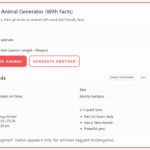
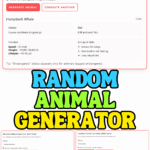
This random animal generator picks 1, 2, 3, or 5 animals and includes quick facts about each one. Choose all animals or filter by wild, zoo, ocean, farm, or threatened and endangered animals.
Random Animal Generator for Kids
Pick 1, 2, 3, or 5 random animals, with optional categories and quick facts.
Add a Link to This Tool
This adds a branded card to a classroom site or blog. The generator remains on Homeschool of 1.
Recent Animals
How to Use the Random Animal Generator
Choose whether you want to generate 1, 2, 3, or 5 animals, then select the full collection or filter it by wild, zoo, ocean, farm, or threatened and endangered animals.
Keep Avoid repeats selected if you want the animal picker to produce different results during your session. You can also choose whether each result shows its speed, weight, and lifespan.
Click Pick a Random Animal, then use Pick Again whenever you want a new result. The selected animals can also be copied or shared.
For another quick activity, try these animal trivia questions for kids.
Generate One or More Random Animals
Picking one animal works well for a quick science fact, drawing activity, research topic, or animal writing prompt. Ask children to identify its habitat, diet, animal group, and an adaptation that helps it survive.
Generate two animals for a comparison activity. Children can compare their habitats, diets, size, lifespan, and conservation status. Selecting three or five animals is useful for classroom assignments, group research, classification activities, or giving each student a different species.
The no-repeat setting prevents the same result from appearing again during that session.
Educational Animal Activities for Kids
This animal randomizer includes familiar creatures as well as species children may not have encountered before. Each result provides concise information about the animal’s habitat and diet, together with several facts and optional statistics.
Younger children can draw or describe the animal they receive. Older students can investigate its classification, adaptations, ecosystem, geographic range, or role in the food chain. The results can also be used for science warm-ups, geography activities, trivia practice, and creative writing.
Wild, Farm, Ocean and Endangered Animals
The generator contains 129 unique animals from a range of groups and habitats. These include mammals, birds, reptiles, amphibians, insects, marine animals, and farm animals.
Select All animals to pick from the complete collection, or use one of the category filters. Use the threatened and endangered filter to generate a random endangered animal and learn about species affected by habitat loss, hunting, climate change, and other environmental pressures.
Some animals belong to more than one category, so they may appear under multiple filters.
About the Animal Facts
The information is simplified for elementary and middle school students. Measurements can vary according to an animal’s age, sex, species, and population, while conservation classifications may change.
For detailed research, students should confirm current information through the IUCN Red List, recognized museums and zoos, or government wildlife organizations.
If you like letting the generator choose for you, there are plenty of other things you can generate at random, including words, letters, names, movies, questions, places, and creative ideas.
More Animal Activities and Printables
When we’ve used this and the interest is still there, this is usually what we move on to next.
- Animal coloring bookmarks – A quiet, creative follow-up that gives kids something practical to use once they’re finished.
- Animal color by number – Reinforces number recognition and fine motor skills while keeping the wildlife theme going.
- Intelligent animals worksheets – Explores problem-solving, behavior, and how certain species adapt in surprising ways.
- Farm animal coloring pages – A natural extension if you’ve been using the farm filter and want to stay focused on domesticated animals.
- Alphabet animals coloring pages – Connects early literacy with familiar creatures for preschool and early elementary learners.
- Animal I spy worksheets – Encourages close observation and attention to detail.
- Habitat coloring sheets – Helps kids visualize ecosystems and compare where different species live.
- Farm scavenger hunt – Adds movement and works well for younger learners or small group activities.

Last Updated on 26 August 2026 by Clare Brown
