
Science Vocabulary Games for Kids

Science vocabulary games are one of the easiest ways to help kids actually remember what they’re learning without it turning into a struggle.
Some of these words just don’t stick when they’re only seen on a worksheet. But as soon as you start using them in a game, even something really simple, they start to click much faster.
These are the kinds of activities that work when you’ve got a spare 10 minutes, need something low prep, or just want to reinforce what you’ve already covered without repeating the same thing again.
Why Vocabulary Games Help Learning
A lot of science words don’t mean much at first. Kids might be able to read them, but that doesn’t mean they really understand them.
What makes the difference is using the words.
When kids are guessing, describing, or even acting them out, they’re thinking about what the word actually means. That’s usually when it sticks.
It also takes away that “this feels like work” reaction. Even reluctant learners tend to join in when it’s a game, especially if there’s a bit of competition or a time limit involved.
Quick Science Word Games
These are the ones I keep coming back to because they don’t need any prep.
Guess the word
Give clues one at a time instead of all at once and let kids guess as they go. Once they get it, ask why they chose that answer. It’s a simple change, but it helps them think about what the word actually means rather than just guessing.
Which word doesn’t belong?
Give 3 – 4 science words and ask which one doesn’t fit. There isn’t always one right answer, which is what makes it work, kids have to explain their thinking, not just guess.
Science charades
This works better than you’d expect. Words like “evaporation,” “orbit,” or “gravity” are surprisingly fun to act out, and it helps younger kids who need something more hands-on. It also reinforces meaning without needing any explanation.
Word association
Say a word like “plant” and have kids respond with the first science-related word that comes to mind. It’s quick, but it helps build connections between terms, which makes recall much easier later on.
Describe it without saying it
Pick a word and describe it without using the word itself. This one tends to get a bit competitive, especially in small groups.
Vocabulary relay
Write science words on one side of the room and definitions or images on the other. Kids move to match them. It’s simple but works well when energy is high.
Science vocabulary journals
Have kids write the word, draw a quick picture, and use it in a sentence. It’s simple, but it helps connect the word to something real instead of just memorizing it.
Categories
If you want something just as easy but a bit more structured, a scattergories-style game works really well. You can set your own categories, or use these science scattergories printables to save time and have everything ready to go.
You can mix and match these depending on how much time you have. Some work better as quick warm-ups, while others are more useful when you want kids to slow down and think a bit more about the words they’re using.
How to Use Science Vocabulary Games
You don’t need to plan a full lesson around these. Most of the time, I just use them in short bursts:
- at the start of a lesson to introduce new words
- in the middle when attention drops
- at the end as a quick review
Mixing games with printables tends to work best. Start with something interactive, then follow it with a crossword or worksheet to reinforce what they’ve just used.
Printable Science Vocabulary Activities
Sometimes it’s just easier to have something ready to go, especially if you’re working with a group or need a quieter option.
Crosswords are one of the few worksheet-style activities that don’t feel like work. Something like this moon phases crossword puzzle is a good example, it reinforces key space vocabulary, but still feels like a puzzle kids actually want to finish.
Word searches work in a similar way. A body systems word search is great for revisiting terms they’ve already learned without it feeling repetitive, and it gives them a bit more time to recognize and remember the words at their own pace.
If you want something more hands-on, animal anatomy worksheets work well because kids aren’t just reading the words, they’re labeling and connecting them to something visual, which makes a big difference with retention.
And if you’re leaning into seasonal activities, this spooky science worksheet is a fun one to mix in. It uses a periodic table decoding activity, so it feels more like cracking a code than doing a worksheet, which is probably why kids stick with it longer than you’d expect.
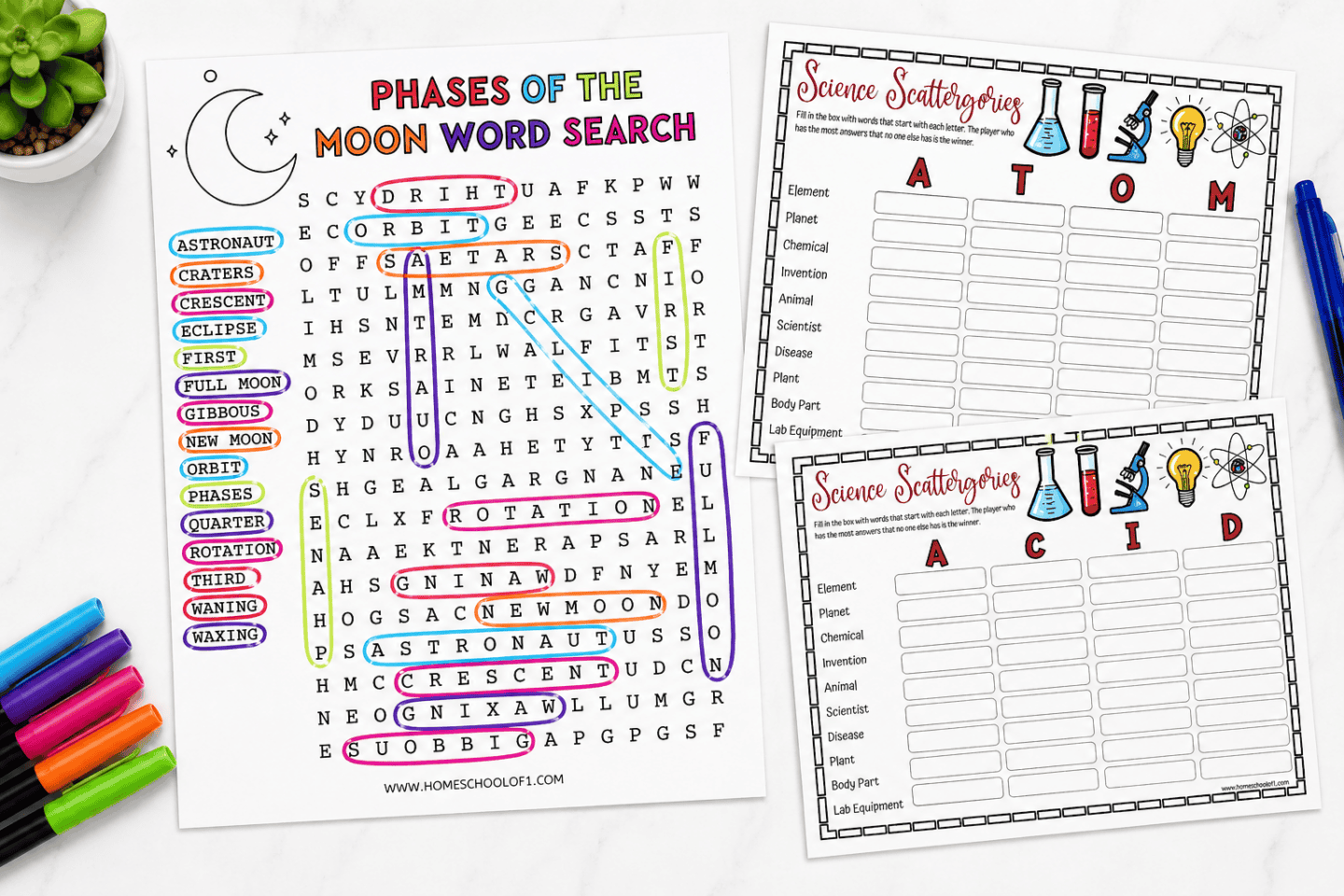
What’s worked best for me is not relying on these on their own. They’re much more effective when you’ve already introduced the vocabulary through a game first, then use printables like these to reinforce it without going over the same thing in the same way again.
Interactive Tools for Vocabulary Practice
This is where things get easier, especially when you don’t want to prep anything.
Using a scattergories-style setup again here works really well, particularly with older kids. Give them a category like “weather” or “space” and a random letter, and see how many words they can come up with. It turns into a bit of a challenge without needing much setup.
Generators are also useful for this. Even something as simple as a random letter generator can turn into a quick vocabulary game, pick a letter and come up with as many science words as possible before the timer runs out.
If you want something more structured, you can turn the same vocabulary into a custom crossword to reinforce it in a different format.
What I like about these is that they don’t feel repetitive. You can reuse the same idea over and over, but it never quite plays out the same way.
Most of the time, you don’t need anything complicated. A quick game, a simple worksheet, and a few minutes of focused practice is usually enough to make those words stick.
