History Books for Kids That Make the Past Easier to Understand

Finding history books for kids that they’ll actually read cover to cover took us a lot of trial and error. Some looked impressive but never got opened twice, while others stayed in rotation for months.
These are the history titles that held my son’s attention long enough to finish them, ask questions, and sometimes go looking for more on the same topic afterward.
They’ve worked as independent reads, reference books during projects, and quick refreshers when we needed context without pulling out a full curriculum.
**This post may contain affiliate links. As an Amazon Associate and a participant in other affiliate programs, I earn a commission on qualifying purchases.**
History Books That Worked Well in Our Homeschool
Some history books sat on the shelf after one read, while others stayed within reach all year because they actually held my son’s attention.
The ones below helped turn history from something we “had to cover” into something he was genuinely curious about, especially when a story or illustration made the time period easier to picture.
We’ve used this mix during structured lessons, quick refreshers before projects, and as independent reads when he wanted to keep going with a topic on his own.
It’s a combination of reference books, narrative nonfiction, and historical fiction that worked reliably alongside our history curriculum without feeling like extra busywork.
A random historical event generator can also work well alongside these books, giving kids a starting point for further reading and research.
Encyclopedias & Reference Books
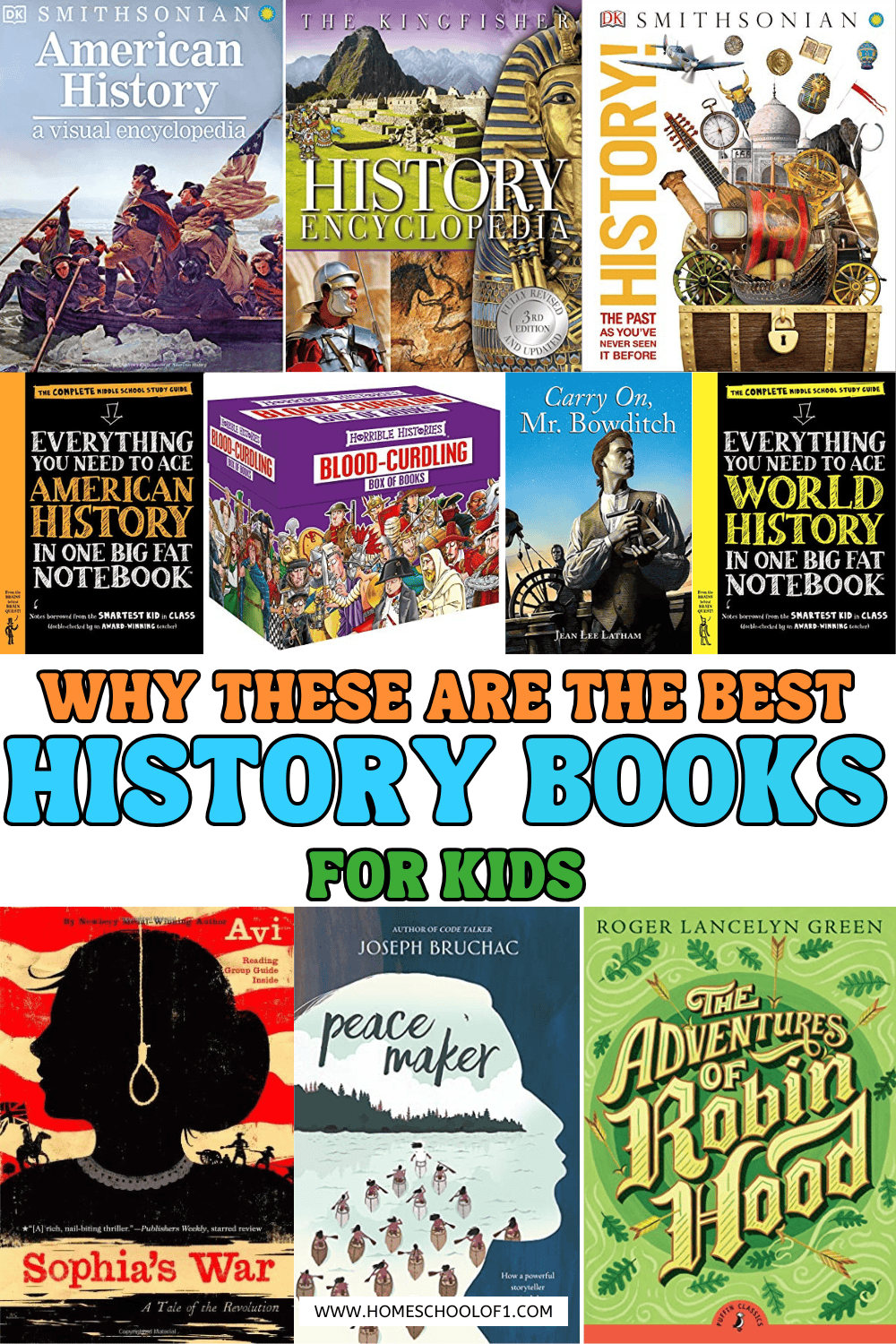
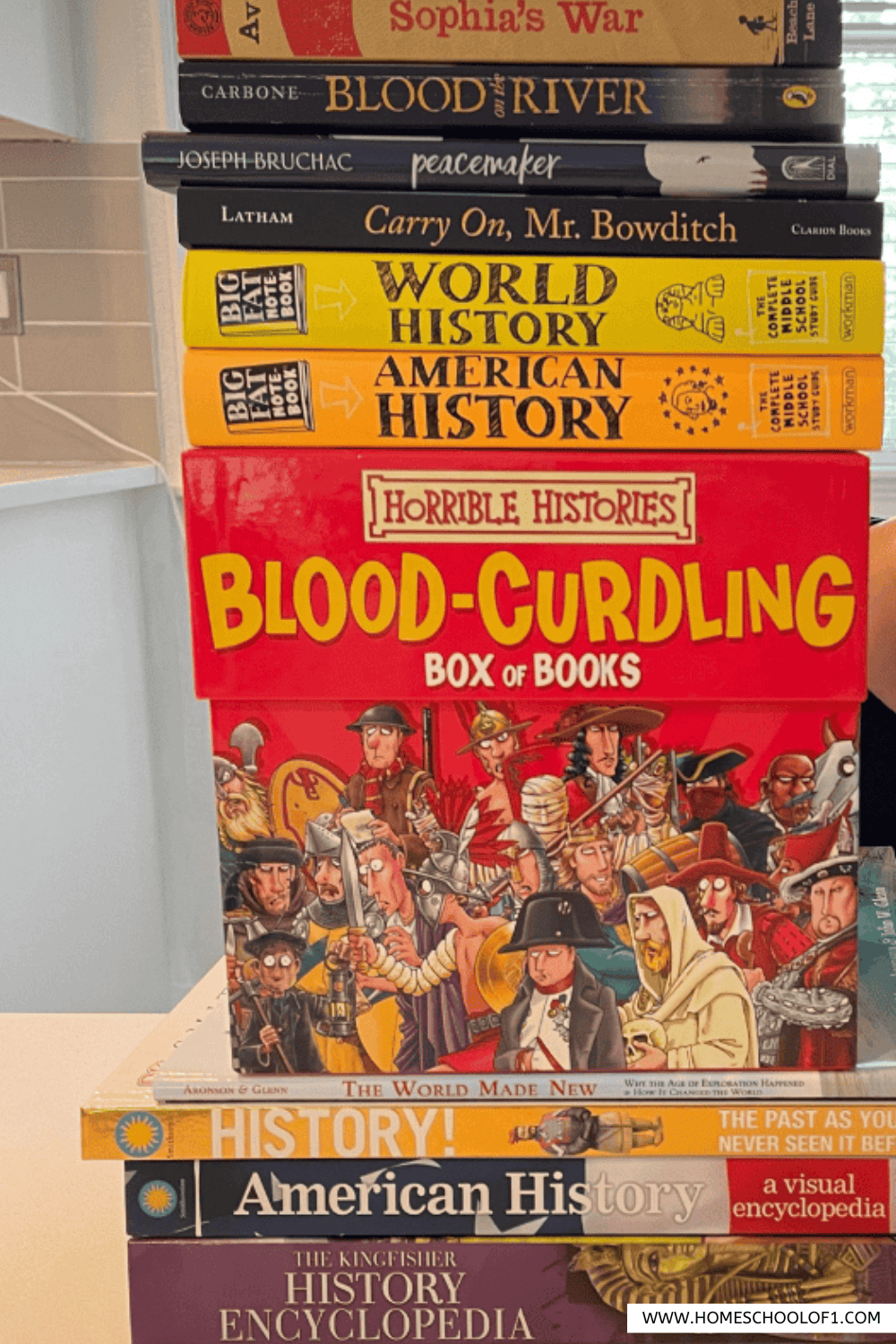
American History: A Visual Encyclopedia – This one worked well when we needed a quick overview without pulling out a full textbook. The timelines and image-heavy pages made it easy to flip to a specific period and get context fast. It was especially useful during American history units when my son wanted to see how events connected rather than read long chapters.
The Kingfisher History Encyclopedia – We kept coming back to this as a general reference because it covers such a wide time span in one place. It’s organized clearly by era, so it’s easy to jump between ancient history, medieval topics, and more modern periods without hunting through multiple books.
History!: The Past as You’ve Never Seen It Before – This was one of the easier history books to pick up casually because the layout is so visual. The infographics and photos helped explain bigger ideas quickly, which made it a good starting point when a topic was completely new.
Everything You Need to Ace American History – We used this more as a review tool than a primary read. The short summaries and structured pages made it helpful for checking understanding or revisiting topics before moving on to something more detailed.
Everything You Need to Ace World History – Very similar format to the American history version, but covering a broader global scope. It worked best for quick refreshers or when we needed a condensed explanation without digging into a longer narrative book.
Historical Fiction Books for Kids
Carry On, Mr. Bowditch – We used this alongside an exploration unit, and it held up better than I expected for a longer historical novel. The focus on problem-solving and navigation gave us plenty to talk about beyond the story itself, especially how someone with very little formal schooling managed to teach himself advanced math.
Sophia’s War: A Tale of the Revolution – This was one of the easier ways to introduce the American Revolution without starting with a dense nonfiction book. Following one character through the events made the time period feel less abstract, and it led to a lot of questions about what was real versus fictionalized.
Peacemaker – This added a perspective we hadn’t covered much elsewhere. The story is quieter than some adventure-heavy historical fiction, but it opened up good discussions about diplomacy, leadership, and the formation of the Iroquois Confederacy.
The Adventures of Robin Hood – We read this more as a bridge between legend and history. Even though it’s a classic tale, it worked well for introducing medieval life and sparked interest in the time period without needing a full history text first.
What Actually Made These History Books Stick
When we tried different history titles over the years, a few patterns became obvious. Books that mixed narrative with facts held attention longer than straight reference texts, especially at the elementary and early middle school stage.
Shorter sections or heavily illustrated pages also made it easier to revisit topics without committing to long reading sessions. If a book connected to whatever we were already covering, it almost always got read more than once.
Accuracy mattered, but presentation mattered just as much. The titles that stayed in rotation were the ones that explained events clearly without feeling like a textbook or a test prep guide.
Last Updated on 10 February 2026 by Clare Brown
