
Connections Game for Kids (Play Online or Create Your Own)

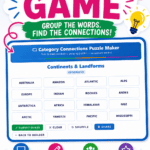
A connections game for kids is a fun way to build vocabulary, critical thinking, and problem-solving skills.
Use the free connections game below to play online or create your own custom puzzles for any subject. Students group words into categories of four by finding what they have in common, making it a great activity for classrooms, homeschool lessons, morning work, and review games.
Choose one of the ready-made puzzles or build your own in minutes and share it with students using a simple link.
▭ Category Connections Puzzle Maker
Build & share vocabulary grouping puzzles — no account needed
Students won’t see category names until they guess correctly.
🌟 Try These Ready-Made Puzzles
10 pre-built puzzles for upper elementary & middle school
How to Play the Connections Game
The Connections game from Homeschool of 1 is an easy way to build critical thinking, vocabulary, and teamwork skills in both classroom and homeschool settings.
Start by opening a game, either pick one of the ready-made puzzles or use a link that’s been shared with you.
Each puzzle shows a grid of words. The aim is to sort them into groups of four that share something in common. Some connections are straightforward, while others need a bit more thought, which is where the challenge comes in.
Select four words you think belong together, then submit your guess. If you’re right, that group locks in. If not, you can try again and look for a different connection.
You can jump straight into one of the ready-made games for a quick start. They’re designed to be used as they are, but you can also adjust them to better match what you’re teaching.
It works well as a short warm-up, a review activity, or something students can work through independently or in small groups without much setup.
Create Your Own Connections Game
If you want something more tailored to your lesson, you can quickly put together your own version.
Start by choosing a topic, then add groups of four words that share a clear connection. This could be anything from science vocabulary and historical events to grammar rules or book themes. The key is making sure each group has one strong, consistent link so students can work it out logically.
Once your groups are set, the game will mix all the words together into a grid. From there, it works exactly the same as the ready-made versions.
When you’re happy with it, just share the link with your students. They can open it on their own devices, which makes it easy to use in class, assign for independent work, or revisit later.
If you’re short on time, you can always start with one of the pre-made games and tweak it slightly instead of building from scratch.
Ways to Use This in the Classroom or Homeschool
This is one of those activities that’s easy to slot into the day without much planning, which is probably why it’s become a regular go-to for us.
It works really well as a warm-up at the start of a lesson. A quick puzzle gets students thinking and focused without feeling like you’re jumping straight into work.
If you’re looking for additional 5 minute warm up classroom activities, quick games like this can help students settle in, activate prior knowledge, and transition into the lesson without needing a lot of preparation.
For subjects like history or science, you can build puzzles around vocabulary, events, or key concepts to help reinforce what they’ve already learned. In English, it can be used for things like synonyms, genres, or character traits.
If you have more than one student, it’s great for small group work too. They naturally start discussing their choices, which often leads to deeper understanding than working alone. That said, it works just as well as an independent activity when you need something meaningful but quiet.
On days when attention is starting to dip, this has been an easy way to keep learning going without it feeling like more of the same.
More Interactive Learning Games
If this works well with your students, there are a few other quick activities that follow a similar idea but with a different focus.
The writing prompt generator is great for getting ideas flowing, especially when students are stuck or reluctant to start. It gives them a clear starting point without overthinking it.
For something a bit more fast-paced, the online Scattergories-style game works well. It’s ideal for vocabulary, spelling, and thinking on the spot, and it can easily be adapted for different subjects.
These types of random games work nicely alongside each other, especially if you’re planning a full lesson or just want a few low-prep options ready to go.
Last Updated on 22 June 2026 by Clare Brown
