Native American Heritage Month Activities

These Native American Heritage Month activities for kids are a great way to explore the people, history, and cultures of Native communities throughout November and beyond.
I’ve gathered a mix of resources we enjoy, including coloring pages, research activities, books, and some excellent free resources from museums and other trusted organizations. You can pick and choose what works for your lessons, whether you have an afternoon to fill or want to explore the topic in more depth.
If you’re planning more activities for the month, you’ll find plenty of seasonal ideas in our November printables collection too.
**This post may contain affiliate links. As an Amazon Associate and a participant in other affiliate programs, I earn a commission on qualifying purchases.**
Native American Heritage Month Coloring Pages
Coloring pages can be an easy way to introduce some of the people you might be learning about during November.
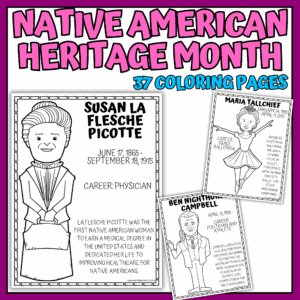
Our Native American Heritage Month coloring pages feature notable Native Americans including Susan La Flesche Picotte, Maria Tallchief, and Ben Nighthorse Campbell.
Rather than using them as a standalone activity, encourage kids to choose someone they haven’t heard of before and find three interesting facts about them. This works particularly well as a starting point for a biography lesson.
Research Influential Native Americans
A biography project is a great way for kids to dig deeper into one person’s life and achievements rather than trying to cover everything at once.
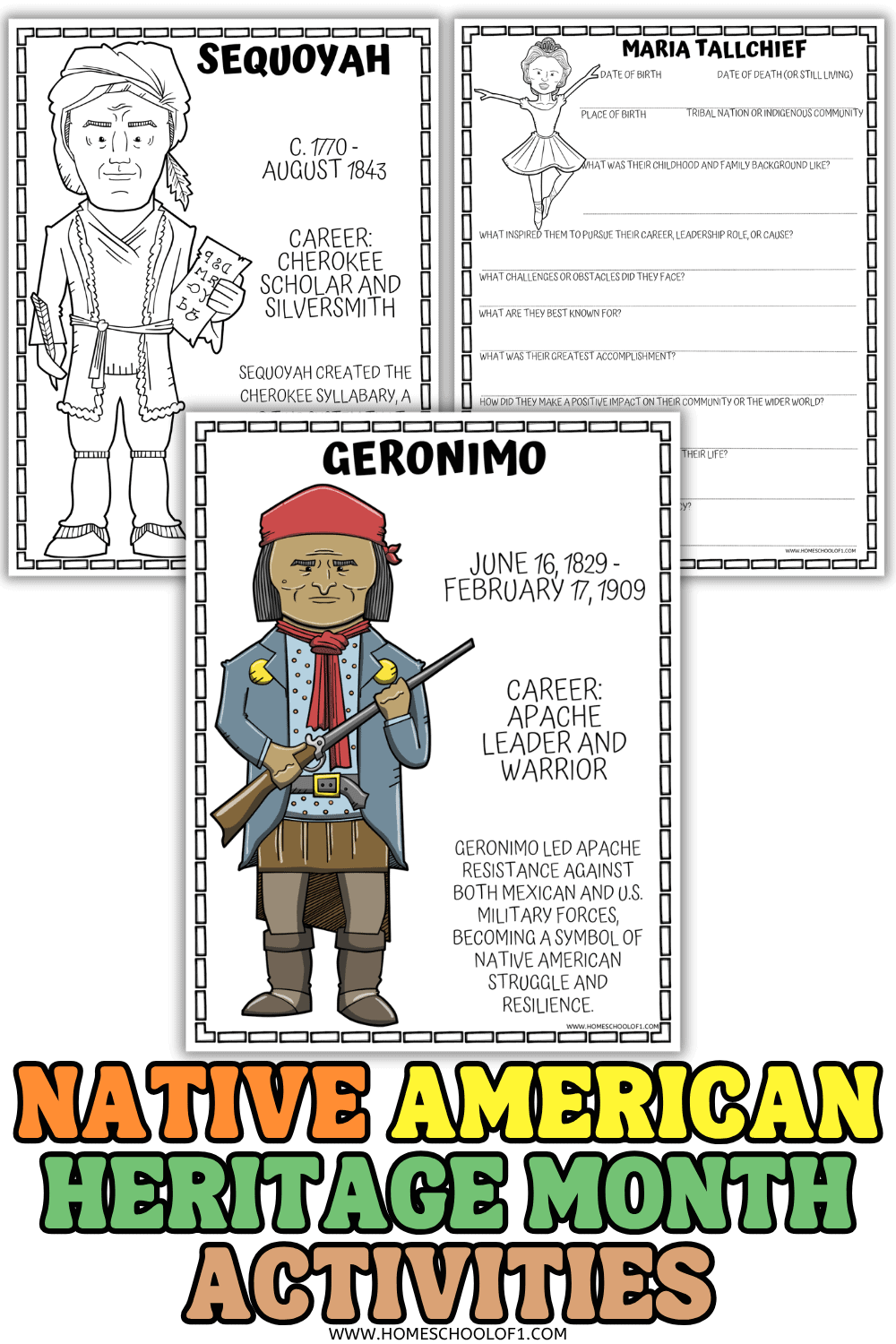
Our Native American Heritage Month research project includes 37 people to choose from, making it easy to assign different figures or let kids choose someone who interests them.
If you’re only studying one or two people, there are also individual activities for Sacagawea, Sequoyah, Sitting Bull, Jim Thorpe, Maria Tallchief, Geronimo, and Chief Black Hawk. Each includes a research activity, coloring page, and poster, so you have everything you need for a short biography study in one place.
I like the idea of letting kids choose someone they don’t already know much about, then sharing a few of their most interesting discoveries when they’ve finished.
Create a Native American Heritage Month Display
If you’re putting together a classroom or library display for November, our Native American Heritage Month posters feature 37 notable Native American figures.
You don’t have to use them purely as decoration either. Choose a different person from the display each day or week and spend a few minutes finding out who they were and what they accomplished.
Older kids could take turns choosing someone from the collection and giving a short presentation about them.
Explore Native American History With Free Online Resources
Some of the best resources I’ve found for this topic are completely free, and they’re produced by organizations with the expertise to cover Native American history and cultures properly.
The Smithsonian’s National Museum of the American Indian has an excellent collection called Native Knowledge 360°. It includes lessons, primary sources, videos, images, and interactive resources covering Native peoples past and present.
It’s particularly useful if you want to go beyond biographies and explore individual Native nations, cultures, historical events, and contemporary issues.
The National Park Service also has free lessons and activities connected to Native American history. These are especially useful when you’re studying a particular place or event in U.S. history.
NativeAmericanHeritageMonth.gov is another useful place to browse. It brings together educational resources from several federal organizations, including the Library of Congress and Smithsonian.
Learn About Native Nations
Another worthwhile activity is to choose a Native nation and learn about it in more detail.
Rather than treating Native Americans as one group, kids can investigate how individual nations have their own histories, governments, languages, traditions, and homelands.
They could choose a nation and find out:
- Where its traditional homeland is located
- Where members of the nation live today
- What language or languages are spoken
- How the nation is governed
- Important events in its history
- What life in the community is like today
The Native Knowledge 360° resources mentioned above are a particularly good starting point for this activity.
Use Maps to Explore Native American History
Geography and history work really well together here.
A visual reference can make this much easier. This Native American nations map shows the locations of Native nations before European colonization and can be used as a starting point for comparing historical homelands with present-day tribal lands.
You could also connect your map work to whatever you’re already studying in American history, such as the Lewis and Clark Expedition, the Trail of Tears, westward expansion, or the development of different regions of the United States.
Read Books by Native American Authors
Books are a great way to introduce Native American experiences from the perspective of Native authors. These three are particularly good choices to add to your November reading:
- Fry Bread: A Native American Family Story by Kevin Noble Maillard – A beautifully illustrated picture book exploring family, food, community, history, and Native identity through fry bread.
- We Are Water Protectors by Carole Lindstrom – Inspired by Indigenous-led environmental movements, this picture book follows a young girl standing up to protect her community’s water.
- Berry Song by Michaela Goade – A lovely story about a girl gathering berries with her grandmother that explores family, gratitude, and the connection between the Tlingit people and their land.
All three offer a look at Native life and culture beyond the historical figures kids often encounter in textbooks.
Investigate the First Thanksgiving
November is also a good time to look more closely at the history behind Thanksgiving and compare it with the version of the story kids may already know.
Our history of Thanksgiving coloring pages explore the people and events connected to the holiday, making them an easy starting point before digging deeper into the history.
For a free activity, the Smithsonian’s National Museum of the American Indian has an excellent inquiry lesson, The First Thanksgiving: How Can We Tell a Better Story? Designed for grades 3–5, it encourages kids to examine historical sources and think about perspectives that are often missing from the traditional Thanksgiving story.
Older kids can take this further by comparing different accounts of the First Thanksgiving, considering who created each source and whose perspective is being represented.
Explore Native American Art, Music, and Culture
History doesn’t have to be the only focus during November.
Choose a Native artist, musician, dancer, author, or other contemporary figure and find out more about their work. Maria Tallchief, for example, provides an interesting connection between Native American Heritage Month and performing arts.
Museums are particularly useful for this because kids can examine actual objects and artworks online and learn about the communities that created them.
Try to focus on specific Native nations and artists rather than recreating generic “Native American crafts.” It makes the activity both more interesting and more accurate.
