Carcassonne Review for Families and Kids

Carcassonne has become one of our favorite strategy board games for family game night.
If you’re wondering what age Carcassonne is best for, how difficult it is to learn, or whether kids actually enjoy playing it, here’s our honest review after playing it regularly at home.

**This post may contain affiliate links. As an Amazon Associate and a participant in other affiliate programs, I earn a commission on qualifying purchases.**
What Age Is Carcassonne Best For?
Although the box recommends Carcassonne for ages 7+, I think 8–10 is probably the sweet spot for learning the rules independently.
Younger kids could still play with help, especially if you simplify some of the scoring at first. Freddie picked up the basic gameplay quickly at 8, although we spent the first couple of games constantly checking the rule book ourselves.
What Is the Carcassonne Board Game
Carcassonne is a tile-laying strategy game where players build medieval cities, roads, monasteries, and fields while trying to score the most points. Each turn, you place a new tile onto the growing board and decide whether to use one of your meeples to claim part of the map.
At first it looks more complicated than it actually is. Freddie was already trying to block my roads on purpose by the end of the first game, even though we were still checking the rule book constantly ourselves.
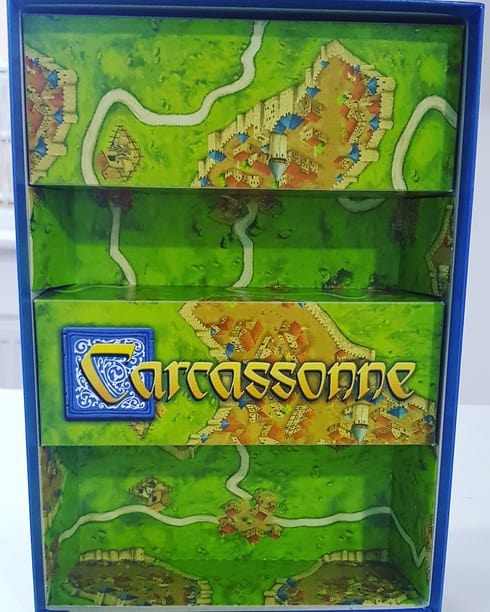
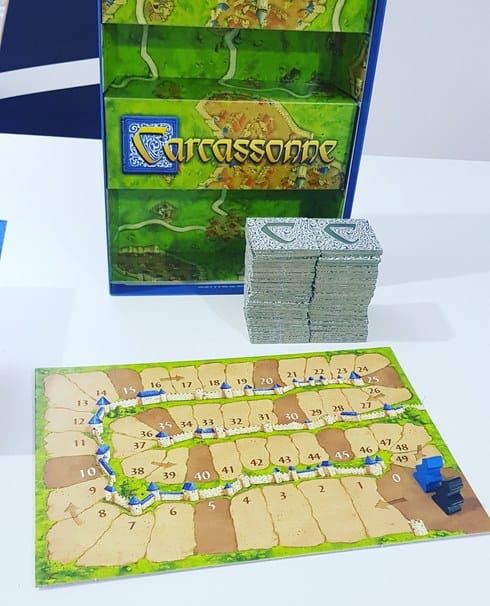
Inside the box are 84 landscape tiles, a starting tile, 40 meeples in different colors, and 5 abbots. The pieces feel sturdy and well made, and the board ends up looking completely different every time you play.
I also liked that it stayed competitive without becoming frustrating. Some strategy games for kids can drag on a bit, but this one moved quickly enough that nobody got bored halfway through.
How to Play Carcassonne
Each player takes turns placing a new tile onto the board to slowly build an expanding medieval landscape filled with cities, roads, monasteries, and fields. The more tiles you add, the more chaotic the board gets.
At first it actually reminded me a bit of dominoes. The difference is that you can also place meeples onto sections of the board to claim them and score points.

After placing a tile, you can choose to add one of your meeples in different ways:
Placing a Meeple on the Road
If another player hasn’t already claimed the road, you can place your meeple as a highwayman. Once the road reaches a dead end, crossroads, or connects fully, you score 1 point for each tile that makes up the completed road.
Placing a Meeple in a City
Meeples can also be placed in cities as knights. When the city is fully enclosed by walls, you score 2 points for every tile in that city. Some city tiles also include coats of arms, which give extra bonus points.
Placing a Meeple in a Monastery
Monasteries are placed within fields, and you score points once the surrounding spaces have all been filled with tiles. These are usually some of the easiest points to keep track of while learning the game.
Once a section has been completed and scored, the meeple returns to your supply so you can use it again later in the game.

End of the Game
The game ends once the final tile has been placed. Players then count any remaining points from incomplete roads, cities, monasteries, or fields, and the person with the highest total wins.
Extra Rules and Expansions
One thing I really like about Carcassonne is that the game grows with you. Once you’ve played a few times, you can start adding optional rules and extra tiles to make the gameplay more strategic.
You can introduce farmers, river tiles, and abbots, which all add slightly different ways to score points and change how the game develops. We still haven’t even tried all the extra rules yet, which probably says a lot about how much is packed into one box.

Our Carcassonne Review
I honestly didn’t expect to like this game as much as I did.
The first time we opened it, the rule book looked far more complicated than I wanted to deal with after a long homeschool day. We skipped parts of the scoring at first and just figured things out as we played.
By the second game though, Freddie was completely into it and had already started blocking my roads on purpose.
What surprised me most was how replayable it felt. Every board ends up looking different, so it never feels repetitive even though the rules stay mostly the same.
I also like that games don’t drag on forever. Some strategy games for kids feel painfully slow, but this one usually ends before anyone gets bored or frustrated.
We’ve played quite a few family board games over the years, and this is one I can genuinely see us continuing to pull off the shelf.

Last Updated on 18 May 2026 by Clare Brown
