
Random Job & Career Generator

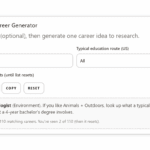
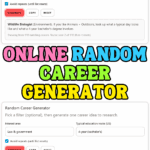
This random job and career generator gives you instant ideas from 381 occupations. Generate one or more jobs, or filter the results by interest area and typical U.S. education route.
Use it for career exploration, classroom activities, fictional characters, or simply discovering professions you may not have considered.
Random Job & Career Generator
Choose optional filters, then generate one or more of 381 career ideas.
Choose filters or leave them set to All, then click Generate Random Jobs.
Saved Careers
Random Job & Career Generator by Homeschool of 1
How to Use the Random Job Generator
Choose an interest area, education route, or leave both filters set to All. Select whether you want 1, 3, 5, or 10 results, then click Generate Random Jobs.
Save any careers that catch your attention so you can compare them later. You can also copy your results or share the generator with someone else.
For a more structured activity, use my career exploration worksheet for middle and high school students to compare job responsibilities, education requirements, salaries, and working environments.
How the Interest Categories Work
The generator organizes 381 careers into 16 broad interest categories:
- STEM
- Health
- Helping People
- Arts & Design
- Business
- Skilled Trades
- Outdoors
- Technology
- Law & Government
- Communication
- Hands-On / Building
- Animals
- Environment
- Food
- Sports
- Military Support Roles
These are simple browsing categories rather than an official career assessment. Many careers appear in more than one because jobs rarely fit neatly into a single area. A wildlife biologist, for example, may appear under animals, outdoors, and STEM.
If you keep saving careers from the same categories, that pattern may be worth exploring further.
Careers That Don’t Require a Four-Year Degree
A bachelor’s degree is only one route into a career. The education filter can also help you find jobs that typically begin with an apprenticeship, professional certificate, associate degree, military training, or employer-provided training.
Electricians and plumbers commonly learn through apprenticeships, combining paid work with classroom instruction. Careers such as dental hygienist, respiratory therapist, and radiologic technologist generally require an associate degree and professional licensing or certification.
Other jobs, including HVAC technician, medical assistant, pharmacy technician, and commercial driver, may begin with shorter training programs. Exact requirements vary by occupation, employer, and state, so always check the current rules before choosing a program.
How to Research a Career You Generate
A random result is a starting point, not a career recommendation. When something sounds interesting, investigate what the work actually involves.
Start with these questions:
- What does a typical workday look like?
- Which skills are used most often?
- Is the work mainly indoors, outdoors, remote, or on-site?
- Does it involve travel, irregular hours, or physical work?
- What education, training, licensing, or experience is required?
- What is the typical salary range, and what is the long-term employment outlook?
- Are opportunities available where you expect to live?
The U.S. Bureau of Labor Statistics Occupational Outlook Handbook provides current information about job duties, education, pay, and projected growth. Students who want a more detailed assessment can also use the O*NET Interest Profiler to explore careers connected to their interests.
You are not choosing your entire future from one generated result. You are building a shortlist and working out what deserves a closer look.
Preparing for College and Career Options
Finding an interesting career can also help students make more purposeful decisions about high school. Compare possible careers with your high school course options and choose electives that let you test different interests.
Students considering college should also keep an accurate transcript and monitor their grades with a GPA calculator. My guide to homeschool record keeping explains what to track so records aren’t being reconstructed during senior year.
Classes, volunteering, job shadowing, part-time work, and career and technical education programs can all help turn a random career idea into something worth exploring further.
Last Updated on 26 August 2026 by Clare Brown
